




Last Updated: May 28, 2026 01:51 PM
Reliable internet access has become deeply woven into everyday life. It’s how students complete assignments, how people apply for jobs, how patients connect with care, and how communities stay informed and engaged. But for many individuals and families, consistent connectivity is still out of reach – whether due to cost, geography, or limited infrastructure. About 80% of Americans have home broadband, meaning 1 in 5 still lack reliable at-home internet.
Nonprofit organizations often find themselves navigating this gap firsthand. From supporting students who can’t get online at home to coordinating services in areas with limited connectivity, the need for flexible solutions continues to grow. At the same time, many nonprofits are being asked to do more with limited resources, making adaptability more important than ever.
Nonprofits regularly operate in:
➜ Remote rural areas with no fixed broadband infrastructure
➜ Disaster-affected zones where cable, fiber, and power lines have been destroyed
➜ Mobile and temporary environments such as vans, tents, shelters, and community pop-up events
➜ Low-income urban neighborhoods where residents face digital poverty despite living near physical infrastructure
➜ Field locations where staff need to log real-time data, upload case files, or access cloud systems without returning to an office
Mobile Wi-Fi hotspots have emerged as a practical tool in this space. They’re portable, relatively easy to deploy, and can be used in a variety of ways depending on an organization’s needs. Whether it’s enabling access at home, supporting staff in the field, or bringing connectivity to temporary spaces, hotspots offer a way to extend reach without requiring permanent infrastructure.
From lending programs to field operations, here are five impactful ways nonprofits can use mobile connectivity to power their mission.
One of the most direct ways nonprofits can make an impact is by lending mobile hotspots to those who need them most. Whether supporting students, job seekers, or underserved families, hotspot lending programs provide immediate access to critical online resources.
Students can complete homework and attend virtual classes. Job seekers can apply for roles and attend interviews. Families can access essential services—all from the comfort of their homes.
Why it works:
➜ Removes barriers to Internet access without infrastructure investments
➜ Supports education and workforce development
➜ Scales easily based on community demand
From outdoor fundraisers to pop-up clinics and community workshops, events often rely on stable internet for success. Mobile hotspots ensure nonprofits can stay connected anywhere, regardless of venue limitations.
Staff and volunteers can manage registrations, process donations, coordinate logistics, and engage event attendees in real time.
Why it works:
➜ Enhances attendee experience with seamless connectivity
➜ Enables real-time data collection and engagement
➜ Eliminates dependence on unreliable venue Wi-Fi
For animal shelters, rescues, and pet-focused nonprofits, connectivity can play a critical role in extending care beyond physical locations. Mobile hotspots enable organizations to provide remote veterinary support, adoption guidance, and pet owner education—no matter where staff, fosters, or adopters are located.
Through virtual consultations, nonprofits can connect pet owners with veterinary professionals for basic care guidance or triage. Foster families can receive real-time behavioral support, while adoption teams can host virtual meet-and-greets and follow-ups to ensure successful placements. 
Why it works:
➜ Expands access to pet care in rural or underserved communities
➜ Reduces strain on in-person clinics and shelter resources
➜ Improves outcomes through faster intervention and ongoing support
➜ Strengthens relationships with adopters and foster networks
Many nonprofit teams operate beyond the office—whether conducting outreach, responding to emergencies, or working directly within communities. Mobile hotspots keep staff and volunteers connected to the tools and information they need in real time.
Case workers can update records on-site, disaster response teams can coordinate efforts more effectively, and outreach staff can access cloud-based systems without interruption.
Why it works:
➜ Boosts efficiency and productivity in the field
➜ Enables real-time communication and reporting
➜ Reduces delays causes by manual processes
With mobile connectivity, any space can become a hub for education and empowerment. Nonprofits can set up pop-up learning centers in libraries, community centers, shelters, or even outdoor spaces.
These connected environments support digital literacy programs, job training workshops, homework help sessions, and more—bringing critical resources directly to the communities that need them.
Why it works:
➜ Offers flexible, location-agnostic programming
➜ Expands reach into underserved areas
➜ Helps build long-term digital skills and independence
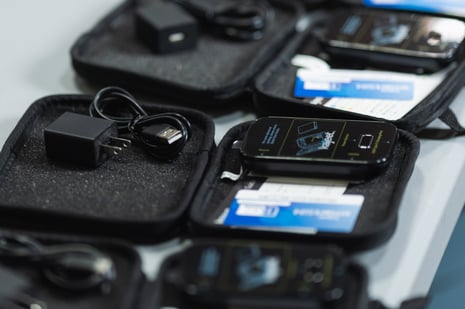
Our Kajeet SmartSpot is a purpose-built, managed mobile Wi-Fi device designed to remove barriers and get organizations connected as quickly as possible. Unlike consumer-grade hotspots that require complex setup, carrier negotiations, or IT expertise, the Kajeet SmartSpot arrives:
➜ Pre-activated on Kajeet's multi-carrier SIM, ensuring reliable coverage by connecting to the strongest network
➜ Pre-provisioned so that the device is ready to use right out of the box
➜ Kitted with everything needed — individual cases, chargers, and a quick-start guide — making distribution to staff, volunteers, or community members fast and straightforward
|
Feature |
Standard Commercial Hotspot |
Kajeet's Managed Solution |
|
Content filtering |
Not available |
Configurable by device or user group |
|
Fleet management |
Not available |
Centralized dashboard with real-time monitoring |
|
Multi-carrier network |
Single carrier |
Optimized for widest coverage |
|
Security controls |
Basic WPA2 |
MDM integration, remote wipe, geofencing |
|
Scalability |
Consumer-level |
Enterprise-grade, scalable deployments |
|
Support for mission use cases |
Generic |
Purpose-built for education, health, and social services |
This plug-and-play approach is especially valuable for nonprofits with limited IT staff or those that need to deploy connectivity rapidly — such as during a disaster response or a large-scale community outreach event.
Connectivity is foundational to opportunity. For nonprofits working to serve and uplift communities, mobile Wi-Fi hotspots provide a powerful tool to expand access, improve service delivery, and operate more effectively.
Whether supporting students, empowering pet owners, or enabling field teams, mobile connectivity helps organizations meet people where they are—and make a lasting impact.
Q: How much do Kajeet data plans cost for nonprofits?
A: Through the Kajeet Connected Communities program, nonprofits can access hotspot data plans starting as low as $8.50/month — one of the most affordable options available as federal programs like the ACP are no longer available.
Q: Does the Kajeet SmartSpot work right out of the box?
A: Yes. The Kajeet SmartSpot arrives fully activated on Kajeet's multi-carrier SIM, provisioned, and kitted with a case, charger, and quick-start guide — no technical setup required.
Q: Can Kajeet solutions support large community events?
A: Yes. The Kajeet Mobile Network Kit is designed specifically for high-demand environments like events, mobile labs, and disaster response sites.
Q: What industries or nonprofit types benefit most from Kajeet solutions?
A: Kajeet serves a wide range of nonprofit sectors, including education nonprofits addressing the homework gap, health organizations running mobile clinics, disaster relief organizations, environmental conservation groups, housing and reintegration services, and libraries managing hotspot lending programs.
Q: How does Kajeet support nonprofits after the end of the ACP program?
A: Kajeet's Connected Communities program was designed to help nonprofits step into the role of direct connectivity provider for their communities — offering affordable managed plans and ready-to-deploy devices so organizations can fill the gap left by the expiration of federal subsidies.

.jpg)



.png)