




Last Updated: August 3, 2026 08:23 PM
For Managed Service Providers (MSPs), delivering reliable connectivity has evolved from a basic service expectation to a mission-critical business imperative. When your clients experience network downtime, they don't just lose internet access—they lose revenue, productivity, and customer trust.
Network outages cost small businesses approximately $427 per minute, escalating to $9,000 per minute for mid-sized operations. For MSPs, this creates both a challenge and an opportunity: clients need guaranteed uptime, and providers who can deliver it differentiate themselves in an increasingly competitive market.
Wireless failover is a backup connectivity solution that automatically switches network traffic from a failed primary connection (fiber, cable, or DSL) to a cellular network (4G LTE or 5G) when disruptions occur. Unlike traditional dual-wired configurations that may share physical infrastructure, wireless failover provides true path diversity through independent cellular tower infrastructure.
Single wired connections typically deliver 99.5% to 99.9% uptime, translating to 43.8 to 8.76 hours of annual downtime. By contrast, wireless failover enables MSPs to offer 99.99% ("four nines") or even 99.999% (“five nines”) uptime SLAs.
This capability allows MSPs to:
Wired fiber installations often take 4-8 weeks to complete, while turnkey wireless failover solutions deploy in as little as 24-48 hours. This allows MSPs to:
Out-of-Band Management (OOBM) represents one of the most valuable, yet underutilized aspects of wireless failover for MSPs. When a client's primary connection fails, the SmartFailover connection provides an alternative management channel that enables:
According to industry data, MSPs fail to detect over 60% of network brownouts until clients report issues. SmartFailover's continuous monitoring transforms MSPs from reactive troubleshooters into proactive infrastructure guardians.
Wireless failover integrates seamlessly into an MSP’s recurring revenue models:
|
Revenue Opportunity |
Implementation Strategy |
Typical Monthly Value |
|
MRR Streams |
Bundle managed failover with data plans and Hardware-as-a-Service (HaaS) |
$100-$400 per location |
|
Tiered Service Levels |
Create "Premium" tiers guaranteeing 99.99% uptime |
15-30% premium over standard packages |
|
Client Retention |
Demonstrate value during outages, reducing churn |
Lifetime value increase of 25-40% |
Traditional redundancy strategies often involve two wired connections that share:
Wireless failover provides true infrastructure diversity by utilizing cellular networks that operate independently from wired infrastructure. When construction crews sever fiber lines or weather events damage cable infrastructure, cellular towers typically remain operational or are prioritized for rapid restoration.
The evolution from 4G LTE to 5G has fundamentally changed wireless failover capabilities:
|
Technology |
Speed Range |
Latency |
Business Applications |
|
4G LTE |
5-100 Mbps |
50-100ms |
Basic operations, email, light cloud applications |
|
5G |
100 Mbps - 1+ Gbps |
1-10ms |
Video conferencing, cloud-based ERP, real-time collaboration |
With 5G-enabled failover, clients can run bandwidth-intensive applications without degradation during failover events. This eliminates the traditional "reduced functionality" experience of backup connections.
Software-Defined Wide Area Networking (SD-WAN) paired with wireless failover enables:
Secure Access Service Edge (SASE) architectures require consistent connectivity to cloud-based security services. Wireless failover ensures:
A growing trend positions 5G not just as backup, but as primary connectivity for:
MSPs are increasingly managing "Wireless WAN" environments as standard service offerings, expanding beyond traditional failover applications.
Failover solutions are continually improving, with new features to support for resilient and intuitive network infrastructure:
Wireless failover is evolving from a network solution to a comprehensive Business Continuity and Disaster Recovery (BCDR) component:
According to industry research, 90% of businesses experiencing significant connectivity outages fail within one year if they cannot resume operations within five days. MSPs offering comprehensive failover solutions directly impact client survival rates.
Key Message: "Never lose a transaction again."
Key Message: "Patient care never waits for IT."
Key Message: "Regulatory compliance demands uninterrupted operations."
A: Some wireless failover solutions use intelligent traffic management to ensure business-critical systems receive bandwidth priority. For example, Kajeet Smartfailover recommends these tiers of traffic prioritization:
This prioritization prevents bandwidth saturation and ensures that revenue-generating and compliance-critical systems remain operational.
A: Yes. Wireless failover solutions are typically designed for multi-location deployments. Look for a provider that allows for:
The global Out-of-Band Management (OOBM) market is projected to grow from $2 billion to $5.6 billion by 2033, driven by MSP demand for remote infrastructure access capabilities.
Consider these real-world scenarios for your clients:
Traditional backup solutions only reveal failures during actual outages—the worst possible time to discover problems. Providers like Kajeet, offer continuous monitoring to give you and your client peace-of-mind:
This proactive approach means that MSPs can confidently guarantee backup performance rather than hoping equipment will function during emergencies.
Wireless failover has evolved from an optional add-on to an essential component of modern MSP service delivery.
These backup internet solutions quickly pay for themselves, often after just a single failover event, while enabling MSPs to offer enterprise-grade 99.99% uptime SLAs that justify premium pricing and reduce churn.
As 5G networks expand, SD-WAN adoption accelerates, and SASE architectures become standard, wireless failover represents not just a protective measure but a strategic enabler for MSP growth and client success.
Most cellular backup solutions operate on a "set it and forget it" model—until they fail during an actual outage. Kajeet SmartFailover eliminates this uncertainty through:
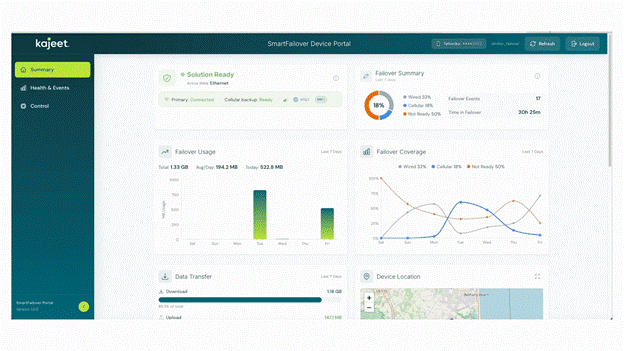
When the primary network fails, SmartFailover automatically routes traffic to the wireless backup. The system includes a pre-configured cellular router, unlimited data plan, and quick-start deployment guide—enabling MSPs to deploy solutions rapidly across multiple client locations.
Ready to transform uncertainty into confidence for your clients? Find out how Kajeet SmartFailover can become your competitive advantage in delivering guaranteed connectivity, reducing operational costs, and building long-term client relationships based on verified performance rather than empty promises.



.jpeg)


.png)